Wednesday, January 30, 2008

Future of my blogging


georgia - 4.jpg
Originally uploaded by jerobins

This is my last post, in reflecting on my first year of blogging. I not only need to evaluate my first year of blogging, but I also need to consider the future of my blogging.

Where do I want to go with my blogging? What do I want to learn and write about? For this next year, I want to post more. In those posts, I want to include:

1. instructional posts

I want to write more on helping beginner bloggers. Specifically, I hope to cover these blogging topics:

  • web analytics.
  • linking.
  • embedding graphics, videos, and presentations from other sites.
  • writing for search engines.
  • comparing writing in short posts and longer explanations.

2. people stories.

Anything we do, we do for and with people. People are fascinating and inspiring. Telling stories about people helps connect concepts with readers. After all, it is about people, not the technologies. I want to write how people have used technologies for improve processes or improve lives.

Additionally, I want to write about people who make a difference.

3. conceptual and idea kinds of posts, possibly, some "what if" posts.

Trying to convey concepts in a way that invokes ideas is something that I struggle with. Gosh darn it, I wish I was better at that. I will keep trying.

4. posts on what I am learning.

I am not sure what I am going to learn. I do know I want to investigate these specific topics more deeply:

5. posts on using social media.

The more I used social media the more I know that I cannot rely on only 1 or 2 tools to communicate. Each tool has a purpose. Some of the newer social media tools open opportunities to communities, learning, and people, but are not full replacement for traditional electronic tools. For instance, email is a good tool for some asynchronous messages. It is, however, often used for the wrong purpose. Instant messaging, blogging, collaboration tools, such as Google docs and wikis, serve us better for some communications and activities.

I want to write more about the importance of using social media technologies, particularly social bookmarking, wikis, Twitter, and any other useful tool I happen to try.

What do you want me to investigate? What topics do you want me to cover in my blog?

Sunday, January 27, 2008

Have I had an impact?


weight 2.0
Originally uploaded by Esthr
What was the impact, if any from my first year of blogging?

My web metrics show that my blog is being read. Sure, I would like to see an increase in the number of people reaching my blog. Though, it is more important to me that the articles help educators understand the potential of integrating technology into our educational programs.

In the first year, I have helped a few people become more aware of reading feeds, blogging, and sharing resources, such as photos, videos, and slide presentations. Several Extension educators have started blogging in a trial stage. Although the idea of social media is spreading in our organization, we still have more work to do. I will keep blogging.

I have not advertised the fact that I blog. Except in the last few months, while meeting with Extension professionals in my own state, I have used my blog as an example in showing them feeds and showing how they can subscribe to feeds. Thus, this is one reason my Feedburner subscriptions have jumped in the last month or so. :)

Several of us in Extension are talking about the importance of integrating social media into educational programs. No one individual can be effecive in bringing awareness and adoption of social media. We each say the message a little differently and we each have opportunities to chip into the influence factor.

Blogging is not the only application I started in the last year. I have also adopted:
The use of each of these applications have helped me learn, understand, adopt and use social media. Through these tools, I am also building an understanding how these tools fit in our organization.

My blog has become a centralized place for instructions and linking to interesting technologies and concepts. My blog isn't only a set of instructions, but rather my thoughts and professional opinion on how we can make our organization better. It is from some of these posts that conversations have been started. In the conversations, ideas are forming.

Blogging is not a one way communication tool. Blogging means participating. Knowing what others are finding and saying is as important as blogging itself. These others tools helped me grow my relationships with colleagues across the country and helped me learn from them.

The influence is not only about how much I have impacted the adoption of these tools, but it is also about the understanding and knowledge that I have gained.

The impact of my blog is not measured by the numbers. Impact is also about how scattered influence is being picked up, discussed, and diffused. Two examples are given in posts about never knowing when and how you are influential. One particular influential dinner conversation with Kevin Gamble sent me to the adoption phase. Another conversation on Sandia Peak sent a Brian Webster to the blogging adoption phase. It is hard to separate whether my blog is influential, because the other conversations that happen are just or more influential.

Blogging is one piece of the strategy. Other social media used and other conversations--those in-person or virtual --all play a part in influence and impact. Maybe the influence of my blog is not measurable, it is important, nevertheless.

Wednesday, January 23, 2008

My blog analysis

dashboard
Originally uploaded by aafromaa

In reflecting on my blogging efforts over the last year, I want to consider and report a few web metrics. The history of my blog is as follows:

January 24, 2007 I began blogging.

April 24, I claimed my blog in Technorati.

Mid-may, I created my own domain and the Technorati rating started over.

Currently, Technorati rank is 587, 893 and Authority is 14. Until last week I had an authority rating of 16.


dashboard
Originally uploaded by aafromaa

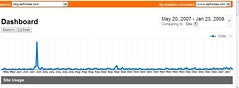
May 22, I started using Google Analytics. In an 8 month time period, the number of visits is to my blog is shown in the graphic.

The most frequently read pages are:

1. My entry page. Time spent on page 2:55 minutes.
2. Extension in Web 2.0. Time spent on page 3:31 minutes. Most of these views came from direct sources. In fact the spike in my visits occurred when Iowa State Extension professionals were directed to this article through an email.
3. A Summary of Advantages of Facebook. Time spent on page 4:57 minutes. Most of these views came from Google searches.

Early Fall, I started using Feedburner. Feedburner reports 92 feeds being subscribed. According to Google Reader, there are 42 subscribers through Google Reader.

Though in terms of number of visits and feeds, these numbers to some may not seem like much. However, the target audience for my blog has been quite narrow. Many of these professionals are just now becoming aware of that social media tools are applicable to their work. I expect the number of subscribers and visits to increase in the next year.

Looking at it differently, I have never in my career have I had the ability to communicate and discuss technologies in a way that reaches this many people this easily, not through email or any other method.

What does this mean for the larger organization? Consider the effect we would have as an organization if a conservative 1/5 of our educators were to start blogging (and linking to each other's materials). Our educational knowledge becomes spread in ways we have never been able to do before now.

If we blogged what we are already doing--the newsletter articles, the everyday questions, and the success stories--the effective and range reach levels we have never experienced. We can do this with fairly little effort . Blogging expands our ability to build communities and improve lives. That is really exciting!

eLearning example

I am always looking elearning examples that I think are effective and interactive.

One such example is
Visible body.
  • It's in beta.
  • You have to register.
  • Registration is free.
  • It requires an Active X install.
  • It requires a lot of memory.
  • It's cool.

Thanks to Jane's E-Learning Pick of the Day for the link.

Tuesday, January 22, 2008

Recapping a year of blogging

It is time to reflect on my first year of blogging (January 24, 2007). My second post laid out specific reasons for my blogging. Have I accomplished my goals? Has my blog made a difference? What do my blog statistics look like? What have I missed? And, what's next?

The most important questions are: Have I, through blogging, made an impact and a difference? Have I influenced someone, even in a small way?

The next several posts will evaluate my blog progress. In this post, I am going to evaluate each of the reasons for which I began blogging:

1. express myself.

Some of my favorite posts do not have a direct relationship with technology. Most of my favorite posts have to do with people who do what is right and having influence. My favorite posts are not the most popular posts. Nevertheless, these are my favorites (in no particular order).

2. maybe teach someone something.
My favorite instructional posts are:

3. teach myself something new.
By blogging, I have learned about writing in templates (Blogger templates) and what works and what does not. I have learned to not focus on the format so much--let the software work.

I have also learned (and still learning) to write for a broader audience. Although my target audience is Extension professionals, and lately, I have broaden that all land-grant educators, I am learning to write for the broader audience. Keeping the target audience in mind helps, but choosing more general words and sometimes general techniques expand the reach to others.


Blogging means that I have to learn and dig deeper than what I actually write. It is like when I am teaching; I have to know more than what I present or teach. I have to know concepts, theory, and facts that don't necessarily get reflected in my writing.

Blogging, in part, has expanded and developed my professional relationships. Other social media tools, such as Twitter, Facebook, del.icio.us have also contributed to developing relationships.

Though blogging itself did not teach me other applications, it has helped lead me to applications like Twitter and social bookmarking, specifically del.icio.us.

4. determine if blogging is something I should encourage as a viable technology for some of my friends and colleagues.

When I first started blogging, I was not sure how blogging would prove to be a good tool for Extension professionals. I conceptually knew that blogging made sense. I did not understand the process of blogging--finding content to discuss, writing for the web, staying current, and consistently updating the blog. I wanted to understand how difficult this would be for typical Extension professionals.

I had to try it to understand it. I am convinced more now that blogging makes sense for enhancing our existing land-grant educational programs and building trust in online communities. These posts describe the fit:
5. learn to blog so I can help others in my organization is using and writing for blogs.

I've written several posts directed at helping Extension professionals learn the processes of blogging.

From the perspective of meeting my personal goals of blogging, I have met those goals. I want to do more, though.

Watch for the next few posts for more evaluation and future goals.

Monday, January 21, 2008

Authentic blogging

After discussions with some educators this past week, reading about authentic marketing, and reading Beth Kanter's stories about the effect of the the Sharing Foundation on Cambodia children, I realized I have not been telling enough stories.

In presentations and workshops, I often integrate stories. I used other people's successes with technology as examples. Why don't I do that more in blogging? After all, my blog's name is Anne's Spot for Stories, Perceptions, Observations, and Thoughts.

In particular, Mack Collier's post on how Mahindra tractors uses of a company evangelist in a Life of a Farm blog for authentic marketing made me realized that telling our story and using our clientele to tell stories would be an extremely effective.

Stories and authentic blogging help make educational presentations more believable. Using clients' problems as the basis for blog posts makes for easy explanations. An example the way Tony Glover, a regional horticulture agent, answers everyday questions about gardening in his blog. Using his knowledge which is based on research, he answers questions like he would answer them to clients, in person.

Incorporating our clients' successes into our blogs serves two purposes:
1. creating situations our clients identify with.
2. marketing our educational programs.

Because Cooperative Extension educators are part of the local communities, passionate about helping people, and experts in their knowledge areas, blogging is a perfect fit for them. The example of Life of a Farm extends the concept of Rick Short's 4 P's (passion, personality, getting to the point, and perseverance).

As Mack Collier points out, clients telling stories is an excellent way to blog. In doing so, the specifics of situations are described, solutions and decisions are explained, and successes are told.

Company Blog Checkup: Mahindra Tractors explains authentic blogging. Beyond the marketing perspective, using authentic blogging to explain educational and information makes a lot of sense.

So now you know: One of my goals for this year is to incorporate more stories into my own blog.

Sunday, January 20, 2008

Google search process

In preparing for a presentation George Simeons of elearnspace has written a wiki article on the history of Google and growing concerns of the privacy and security issues.

The majority of the article is an easy to follow, interesting, and informative explanation of the history of Google. The article is written for non-geeks.

If you want learn, just for the sake of learning, start with George's wiki page and follow the links.

Monday, January 14, 2008

Banning Google, Why?

Why would you ban Google and Wikipedia as research tools for students? How does making the information hard to find help students? I simply cannot think of any reason that would justify holding back information. If you want students to search more, then add more references or develop methods for evaluating their ability to synthesize the material.

Students with lots of information should be able to develop more in-depth understanding. Taking the information away will not help students synthesize better.

Online research
One step should lead to another. When I conducted research for my dissertation (finished in 2006), sometimes I found it difficult to find the information and research resources within journals. Journals are often protected and I could not easily or quickly get the information. When I found myself stuck, I used Google. I did not use Wikipedia, but I could have. Generally, the resources I found helped me understand concepts and terms that I might have missed in my journal searches. Then I would go back to the journals.

Additionally, I used Google to find resources on Structural Equation Modeling. It was easier to work through my statistical problems using this method than finding professors who had students at all levels at the door. Certainly, I knew my research better than they did and I knew what I was looking for in trying to re-learn this statistical method. For final approval on my methodology, I would, of course, check with my professor. Of course, this method of learning led to my learning about situations and handling problems in SEM. It was tough staying focused sometimes on my tasks because I kept wanting to learn more.

Google was often a great jumping off point. If I were conducting my research today, I would definitely use Google and Wikipedia, but I would also use other resources, such as social bookmarking, wikis, open classrooms, and open textbooks. Those tools deserve their own discussions; that will be another post one day.

In case you are interested, my research was a multidisciplinary approach to technology use in agriculture, specifically in precision agriculture. I had over 110 references from agriculture, psychology, behavior change, sociology, economics, information systems, organizational change, and management from books, journals, and a few online links.

Additionally, as I work toward publishing some of this research, I am favoring online journals. At least then, the material would be searchable.

Disabling my use of Google would not have helped me understand and learn all these different concepts that were necessary. More than likely, I would have learned a lot less.

School-age learners
Recently, my middle schooler was working on a science project on volcanoes. She used Wikipedia, Google, her textbook and whatever was provided to her at school. When she asked for advice, I helped her go back to Wikipedia and Google and follow the links to even more information.

On the final night of preparation, I asked her, "How would you have done this science project without Google?" She stared at me, like that would be an unbelievable situation--something she could never imagine--like that would never occur. Then she said: "That would suck".

Okay, I know I need to help with her vocabulary. But, she knows a whole LOT MORE about volcanoes than I ever learned in one text book and a school library.