Showing posts with label personal learning. Show all posts

Wednesday, April 2, 2014

Guest lecture on Extension engagement and eXtension

I was asked to guest lecture for a graduate level Extension Methods class and to cover in 40 minutes eXtension, use of social media in Extension, engaging traditional and non-traditional audience via technology. Other instructions were: “Have some fun with the group. Include anything (relevant) that you wish you knew at a young Extension agent/ what skills will tomorrow’s agent need to be successful.”
I was rushed and frankly did not prepare enough for an explanation of eXtension. This post is my attempt to explain eXtension and share openly some of the discussion. I am trying to become better at “working outloud” as Harold Jarche drove home the point in the panel discussion at National eXtension Conference.


I start most of my presentations with questions to the people in the room. The answer to the first question, “What is Cooperative Extension’s best resource?” is always “its people”. I have never heard anything different. The reason I asked this question is that it is people who build relationships. It is those relationships should be made and maintained online—just as we expect Extension professional to establish relationships in their physical meetings.
The second question was: “What makes Cooperative Extension the best choice—the optimal choice—possibly the only choice for its mission?” One lady answered it is the people and diversity of expertise Extension has (apologies to the engaging lady for my severe shortening her response. The other response was that Extension provides research-based information.
By all means Cooperative Extension needs to continue to provide research-based information, but Cooperative Extension is not the only organization or individuals who are doing that. Citizens provide research-based information as well as other universities. We are all aware of that there are many people and organizations that share information that is not grounded in research. We also have to remember that research can sometimes provide mixed, conflicting, and undecipherable information. There is growing evidence that the trust of universities is waning. People do trust other people who are in their friend and colleague circles.
There are several references on the topic of trust in universities. These are just a sampling:
Cooperative Extension’s Past
At one time, everyone knew the Extension agents. Extension agents were seen as responsive. They not only provided home & farm visits, but they included farmers and others in research. The local Extension agent was known as the link to the land grant universities. They were the connection to the most recent research and they were the ones who introduced young people in the community to higher education and land grant institutions. Extension agents were a part of the elite group in the community with college degrees.
Cooperative Extension’s Present
 In 1993, Dave King wrote a Journal of Extension article about Cooperative Extension’s image deficit. We also know from the 2009 Copernicus study that the younger the generation is less likely to know of Cooperative Extension or will have ever used Cooperative Extension. Though the study concentrated on the branding issues and not making the link from our flagship programs—4-H and Master Gardeners—I also believe that we are not reaching enough people. The study also showed that for those people who have used Cooperative Extension they thought Cooperative Extension provided value.

Who has heard of and used Cooperative Extension?


We can’t talk about changes in last few decades without talking about the significance of Tim Berners-Lee proposal in 1989 that created what we now know as the Web. Berners-Lee released the code for free for an “information management” system. We not only owe Berners-Lee for his foresight in technology but also his vision and continued voice in understanding the depth and breadth of the advantage of that the “free code” and campaigning for Net Neutrality.

John Hartley, a student in the class, referred to some opinions that mobile devices are killing the idea of hyperlinks because data are sitting in silos and not including hyperlinking—the foundational concept of the Web. The social online abilities are obvious changes as well.

Skills for Cooperative Extension Professionals.
We briefly talked about the six drivers of change that the Institute of the Future describes in their report on the work skills needed for future knowledge workers.  The drivers are: rise of smart machines and systems, globally connected world, superstructed organizations, new media ecology, computational world, and extreme longevity. In this report, IFTF describes 10 skills needed for the future.

We also talked about the Extension Committee on Organization & Policy (ECOP) sponsored a study on the skills needed for the 21st Century Extension professional. Skills from both of these studies are shown in this table.  


Future of Extension
In one slide I talked about the future of Extension and these are some of the things that I discussed that Cooperative Extension needs to be doing:

  • Build new relationships and maintain traditional relationships online.
We cannot scale ourselves by with our current face-to-face relationships. Also there are many potential clientele who simply do not have a desire to drive to the county office or attend a physical meeting. Even some of our current clientele are asking for more flexibility in learning opportunities.  
  • Learn informally through information flow and others online.
Cooperative Extension professionals are the epitome of knowledge workers. Extension, like many organizations, does not have the capacity to provide all training and knowledge to its professionals. Cooperative Extension professionals should have the desire and flexibility to learn informally from others through online networks. Using the relationships with others to filter and focus on pertinent information. 
  • Seek diversity.
Cooperative Extension has tried to provide services and employment by seeking demographic diversity. We also need to be more cognitive of seeking out clientele and others who have different political ideals, social beliefs, disciplines, and culture. Diversity of thought provides opportunities for innovation and improvement our reach and impact of our programs.
  • Integrate research and extension beyond what we currently do.
  • Know that we are not the only experts and that complex problems cannot be solved and forced (i.e., through logic models).  
The Cynefin framework describes how solutions for complex problems derive different results and cannot fit into neat model. Rather that complex problems should be address in a probe, sense, and respond.
  • Learn outloud and curate.
    • Extension has traditional been very good curators, putting information into context and meaningful descriptions. To increase our reach and impact, we should provide our knowledge and curate online in open and transparent forums.

A few of my own thoughts on the attributes are a successful future for ExtensionTransparency and openness in our work, decisions, and findings.
  • More open licenses.
All Cooperative Extension materials were public domain before 1990. Creating and scaling our work cannot be done easily through all rights reserved products (Creative Commons licenses that allow for easy sharing and remixing).
  • Inclusion of people outside of Extension, particularly passionate amateurs in our work this allows for scaling our work without growing our organizations.
  • Ability to test (and fail) more easily to acquire more agility and innovativeness.

eXtension
There is no federal or centralized system for Cooperative Extension. Cooperative Extension obviously has federal ties with USDA, ECOP and Association of Public Land-grant Universities.  eXtension provides opportunity to find synergies across state lines with a national online presence. eXtension is more than a web site—it’s a presence, it’s professional development, and it’s a mechanism to breakout of our geographic buckets.

eXtension is currently funded through New Technologies of Ag Extension (NTAE) and assessments from the Cooperative Extension institutions.

Content is built through collaborative efforts among Cooperative Extension faculty. Communities of Practice (CoPs) provide the mechanism to develop content (content is more than the text, content is also videos, webinars, social media, etc.). There are opportunities for
CoPs sometimes include others outside of Cooperative Extension. www.extension.org is the hub for eXtension.

Ask an Expert https://ask.extension.org/ is an opportunity for anyone to ask questions on through widgets. These widgets can be installed on any web site. AaE provides one-to-one engagement prospects that are analogous to telephone calls that come into county offices.  People ask questions through Ask an Expert widgets and Cooperative Extension/University staff and volunteers answer them. AaE widgets can be customized for area of interests—generally around the CoP topics or locale. Many county offices use the widgets and direct the questions to their own staff. Questions can be distributed throughout the Cooperative Extension system, in other words the system has the “local offices’ back”. A public option is available for the questions so the questions can be searched and commented on increasing the opportunities for discoverability and engagement.  Reports are available by state and individual. This feature is helpful for end of year reporting for Extension professionals.

There were 48,000 questions last year answered through AaE. 54% of the people asking questions had never heard of Cooperative Extension. 44% of the people described that their questions had some or significant economic value.

Texas answered the most questions. Many questions come from metropolitan areas, like Houston (Harris County).

Learn https://learn.extension.org/ is a listing of synchronous online professional development and other learning opportunities. Events listed maybe hosted by eXtension, others in Cooperative Extension and other entities. Anyone can post events in Learn with Google, Twitter, Facebook or eXtension IDs.  Each page for each learn event can serve as holding place for everything related to the event. Those posting the events can include descriptions, time, dates, connection information, slidesets, additional reading material and recording links.

Those interested in the events can add them to their calendar, follow the event for changes, and comment on the events by logging in with Google, Twitter, Facebook or eXtension IDs.  Those who “follow” events can see are listing of all the events they participated and presented.

There were 494 webinars listed in Learn in 2013.

Campus http://campus.extension.org/ is an asynchronous integrated online learning platform using Moodle. Campus provides course delivery tools and services that can uniquely combine web pages, videos, books, lessons, assignments, forums, chat, certificates, databases, glossaries, quizzes, journals, and questionnaires into personalized learning environments.
Courses can have closed or open enrollments. Courses can be fee-based or free.

The CoPs issued almost 15,000 certificates in 2013 and had 21,000 active users. There are more than 573 courses in Campus.

Create http://create.extension.org/  is the main place where the CoPs collaborate. Create is also used an internal work space. When articles are written collaboratively in Create, reviewed by peers, and copy edited they are then published to published to www.extension.org  where the content is indexed in search engines. Though anyone can see the content in Create, one must have an eXtension ID and belong to the community to edit anything in Create.

People https://people.extension.org/  is where one obtains an eXtension ID, creates a profile, list social networks and interests, and indicates profile settings for Ask an Expert, Create, Learn, and Data. People serves a springboard for any work that requires an eXtension ID. People is great way to find communities and colleagues .

In closing, I proposed these questions for the students to consider:
  • What are the forces important for Extension and land-grants to adjust to?
  • What should Extension focus on that will make us successful in the future?
  • How do those focus areas affect our work force?

References

Starting to work out loud by Harold Jarche http://www.jarche.com/2012/12/starting-to-work-out-loud/

National eXtension Conference Master Panelists https://learn.extension.org/events/1548

Online book, Trust in Universities, written by academics address several issues with trust in universities. http://www.portlandpress.com/pp/books/online/wg86/default.htm
Facing the Image Deficit by Dave King http://www.joe.org/joe/1993fall/tp1.php)


An analysis of the priority needs of Cooperative Extension at the county level by Harder, Lamm and Strong http://www.jae-online.org/attachments/article/56/Harder_etal_50_3_11-21.pdf


How the iPhone is killing the ‘Net http://www.networkworld.com/news/2008/040908-zittrain.html

The 21st Century Extension Professional (the ECOP sponsored study) Webinar and Slideset  https://learn.extension.org/events/1073

Skills for 2020 Knowledge Workers http://www.iftf.org/futureworkskills

Learning and Working within a Learning Network


Other recommended readings:


Harold Jarche’s blog: http://www.jarche.com/

Ongoing finds in connected organizations http://www.scoop.it/t/connected-communities

Ongoing finds in personal learning http://www.scoop.it/t/approachtolearning

Dave Gray’s eXtension National Conference Keynote https://learn.extension.org/events/1544


Jane Hart’s eXtension National Conference Keynote https://learn.extension.org/events/1546

Jane Hart’s blog Learning in Social Workplace http://www.c4lpt.co.uk/blog/


Tuesday, July 9, 2013

John Seely Brown's Global One-Room Schoolhouse

Thanks to Stan Skrabut sharing this video in Google Plus.


The Global One-Room Schoolhouse: John Seely Brown (Highlights from his "Entrepreneurial Learner" Keynote at DML2012) from DML Research Hub on Vimeo.

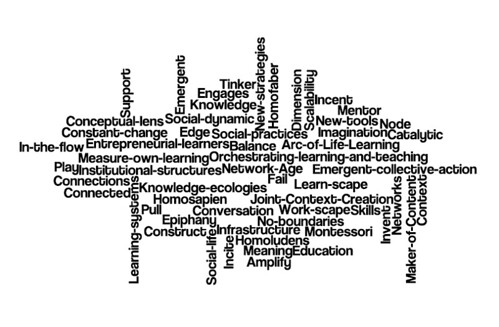
I watched John Seely Brown's video Global One-Room Schoolhouse and Entrepreneurial Learning twice and wrote down words and phrases that resonated with me as important to understand. Some are concepts that I am afraid we are not seeing and understanding because we are so very tied to the traditional, one to many, industrial educational model.
John Seely Brown Global One Room Schoolhouse
As knowledge workers and educators, we are responsible for understanding our own effectiveness and lack of effectiveness and for understanding how our work and decisions will affect our failure or success in the future.
If institutional structures of learning--institutions of schooling, universities and research universities education and universities and look the same as they do now, we have problems. (paraphrased around 1.12 mark)
Recently I have seen reports from some administrators and educators on the skills that they think that we need in the future for public education. The report was disappointing because what some educators see as necessary for the future is based on the way we have worked in the last 30 years.

Brown's analogy of the advantages and environments of the one room schoolhouse reminds of the effectiveness and why we should be return to Seaman Knapp's and George Washington Carver's Extension models.  

Access to more and different kinds of information, joint context creation, co-learning, and contextual ubiquitous learning means we should be asking:
How do we transform from a slow moving steamship set on a course to kayaking into the flow?  (paraphrased around the 2::00 minute mark)
We better be creating arcs of life learning, creating content in joint contexts, participating in ever-changing knowledge ecologies, and orchestrating learning for ourselves and others.

I would love to see examples of institutions looking at learning in this way. Hopefully, you can point me to some examples.


Tuesday, June 4, 2013

Continuous Beta and a Healthy Dose of Paranoia

This is the original script for the Iowa State Cooperative Extension Virtual Conference keynote address. The presentation can be found www.slideshare.net/aafromaa. The recording of the keynote can be found https://connect.extension.iastate.edu/p2ehodt6g48/ 


Continuous Beta and a Healthy Dose of Paranoia

Before we get started I want to applaud you, the organizers of this conference, and your administration for developing a state conference different from any other. Cooperative Extension has conducted other virtual conferences—the first one I spoke at was in 2009 when North Carolina State held a statewide technology virtual conference. eXtension has hosted several virtual conferences. This one, in Iowa, provides the efficiency you would expect but also folds in other concepts like a flipped classroom and a blended approach. I congratulate you on trying something new and taking a risk.

My discussion today will be based on a few concepts of changes and why we need to look at our work and the way others work differently. We will also discuss some skills we need to work in this new environment. We will look at how a fast and continuously abundant flow of information, including noise, makes it harder for us to listen and to be heard. It also gives us great opportunities for inclusion and diversity and how “do it yourself” creativity, innovations, and research are important to our work. They cannot be ignored. Hopefully, the discussion today will help us understand how interconnected we are to the forces of change.

The part of the title “Continuous Beta” is the first concept of change we will discuss.

Continuous Beta

Are you, both personally and professionally, and is Cooperative Extension ready to perform, produce, learn, connect, communicate, and make a difference in a perpetual beta environment? The term perpetual beta comes from the idea of keeping software in a beta development stage for an extended time maybe indefinitely. A beta stage is where software is usable but not completely tested in multiple and unforeseen situations. The advantage of having software or some systems in perpetual beta is that these systems can be changed rapidly allowing for continued development. Continuous beta also means that the system is agile.

Obviously continuous beta is not suitable for mission critical systems—such as airline traffic controls and selling products if that is your bread and butter. A beta stage to Cooperative Extension is attractive because the environment in which we are trying to make a difference is complex and influenced by fast flowing and abundant information from vast and diverse sources.

As we look at solving complex problems, we may want to look Dave Snowden’s Cynefin framework. Complex problems have no known solutions and to solve complex problems we need to probe sense, respond, create emergent solutions and then repeat as we learn. So you see there are reasons to develop a Beta mentality about our work. We are in a time that Cooperative Extension is needed more than ever, but our successes will depend on whether we can listen and assess needs in new ways, be agile, rapidly rapidly, include others outside of the land-grant system, and be willing to experiment.

The Connected Worker
The Connected Organization
The next concept of change is Connectedness.  We are now connected in ways we have never before. We can Skype across the world, we can conference, share documents, and simultaneously or asynchronously edit those documents, we can share our most endearing, most embarrassing, and most mundane moments with select friends and with the world.  We can play games of strategy, bartering, and power with people all over the world and while playing these games we can have social interactions—conversations beyond the game itself.

We can take a class with thousands of others. In that class, we can select who we want to collaborate with, study with, and help and get from, with the intention of never meeting our classmates or our teacher. We can create music, movies, computer programs, and science projects with strangers. We can play music with others in outer space. If we are not the connected worker, we simply are not reaching enough people with the same goals.

I know many of you are very well connected in your local communities. That has been Extension’s model. Embed Extension agents in communities to build credibility, access needs, and help to solve problems, and change behavior—all to improve lives and our communities. The 2008 Copernicus survey found that only 27% of the population had ever heard of Cooperative Extension. Only 11% had used Cooperative Extension at least once in their lifetime. When we look at the numbers in the 18-35 year old age group, these numbers are incredibly dismal. I suspect the numbers in Iowa are better than the national numbers—but not greatly.  Cooperative Extension simply has to reach be more relevant, reach more people and brand ourselves better.  

Nodes of Networks

The fact is that we are part of many networks.

In the 50s and 60s and possibly the 70s, Cooperative Extension could set the norms of communities. Often times, the county agent was one of a few people in the community besides the local doctor, veterinarian and possibly the preacher, who had a college degree. We still hear stories today of how Extension agents were the connection to the land-grant universities. In strong 4-H programs, this may still be true.

However, the environment has changed and we are not the only ones in local communities with college degrees. This is a success of Cooperative Extension—we helped people in local communities understand the value of higher education. 

We simply can’t be setting the norms if people don’t know who we are. Instead we are now members or nodes within many networks. These networks are interconnected. The bigger the node—the more connected and possibly more influential. Our individual roles vary across networks.

When we think of ourselves as being a node within a network rather than being the one person of authority, we should change the way we do business.

More people can develop content. Yes, there is a ridiculous amount of noise. We also know that serious amateurs are doing research and are creating content that is research-based. Yes, some of content generated is biased. But remember, if we are not setting the norm (albeit we probably can name few exceptions), and we are nodes within networks.

Another reason we are not setting norms in communities is that the amount of information today available is almost incomprehensible. Every two days we create as much information as we did from the beginning of time up to 2003.

Let’s look at some examples.

Frank Kovac, a Wisconsin millworker, always dreamed of becoming a director of a planetarium. However, college math was definitely a trouble spot. Without a college degree, he was determined to fulfill his dream. He built his own rotating planetarium and you can visit the planetarium in Wisconsin.

A 15 year-old finds a new way to detect pancreatic cancer. This new way is simpler and less expensive and can be performed much earlier than the current method.

A homeless man finds a way to hack sites and becomes employed. Isn’t this exciting? Everyone can make a difference. Serious amateurs can provide innovative and useful contributions. 

So what is Extension’s role in local communities and online? I say this as if local communities and online communities are separate—they are not. We have only one life. The two are not separate. Local communities extend themselves online as well. We are members of interconnecting networks.

Communications and knowledge expertise is no longer in a hierarchy one-to-many structure like many traditional educational models. There is now dynamic flow of power and authority based on knowledge, trust, credibility and a focus on results, which is enabled by interconnected people and technology. In other words, a few experts no longer hold the authority of knowledge and information. Harold Jarche says that organizations need to learn as fast as their environments.

Is Cooperative Extension learning as fast as the economy changes, adjusting as fast as technology advances, and adjusting to the increasing flow of information? 

Can we learn to work in a wireachy knowledge environment rather than hierarchical one?

Disruptive Innovations

Disruptive technologies are innovations that put unwieldy businesses out of business. Kodak did not respond to the rise of digital photo technology and the change in customers’ and potential customers’ behavior.  Are we in Cooperative Extension blind to the pressures of public accountability, funding responsibility, and changing information political, and economical environment? 

Disruptive innovations provide new value through new products, processes, or concepts. Extension work can be affected by disruptive innovations. Mobile computing has led to mobile lives.  According to Prosper Insights & Analytics
60% of smartphone owners say they cannot live without them.

Wearable computing and Google glasses will bring new meaning and opportunities to ubiquitous computing, visual application, and geolocation. Wearable computing will provide new opportunities for sharing and contextual information. Wearable computing will provide new challenges particularly to privacy concerns and information filter abilities. Google glasses and wearable computing increases data, choices, sharing, and perspectives in ways we cannot imagine.

Let’s consider what your own faculty described. Nancy Franz and Ronald Cox in the Journal of Extension offer these reasons as to why Extension does not embrace disruptive innovations as threats or opportunities. The bolded ones are the ones I am most concerned about.
·         Lack of urgency to innovate
·         A lack of diversity in customer base and staffing
·         Strong linkage to academia, bureaucracy and historic slowness to react to change
·         Lack of operating with a business mindset
·         An expert model paradigm rather than collaborative paradigms with clients
·         Over reliance on rural customers
·         A lack of customer management/tracking over time
·         Status quo 
·         Over dependence on past sources of funding

The challenge is to not get in the way of innovation and to develop structures that support the messy process of experimentation, creativity, innovation, and failure. 

Big Data

What do we mean by Big Data? Everything—purchased, searched, shared and every response and location can be and will be recorded. We have entered a time of having increasing information on almost everything. Companies use this information usually in aggregate to targeted marketing messages and these tactics are becoming more and more just-in-time.

For instance, at big sports events, phone companies gather data on users within in specific location and the data are combined with demographic data and are sold in aggregate to marketers. Companies can determine if sponsorship at a venue drives sales. Big Data allows companies to see trends and patterns to make production and service decisions as well.

Big Data also provides community, health, environmental, finance, and economics information. We will continue to amass more data that can better predict epidemics, for instance. Big Data means that more sophisticated analytical tools need to be created. Not only will we need better decision tools, but also knowledge workers will be called on to have higher levels of sense-making skills and programming skills.

On a negative side, there is no doubt that people will grow more concerned over privacy invasion.

Extension’s role is to understand the implications and how to decipher and make sense of findings. We have great potential in helping others understand the benefits of big data and the changes in privacy. We need to be able to filter and interpret the information.

We must be agile in working with a variety of organizations in coming up with practical solutions—possibly on the fly. In times of crisis, we may not be able to have tested research in hand. Are we positioned to react in minutes, hours, days, and weeks? Months will possibly be too long.

Race with the Machine Economy

We are now already in a data, knowledge, and service economy.

Big data, machine automation, machine learning, artificial intelligence, knowledge automation and services are changing economies.

MIT professors, Erik Brynjolfsson and Andrew McAfee, tell us that the traditional method of measuring economic growth does not accurately measure the value in innovations, services, and current economic changes. The knowledge and service economy does not adjust to government and other interventions as when we were in the industrialization age. During the industrial age, manual laborers shifted from rural locations to urban locations.

Innovations in service industries and technological advances don’t displace only the manual laborers. Machine/computing automation has already replaced people like bank tellers. Knowledge automation or artificial intelligent systems are replacing tasks performed by higher level knowledge workers, such as legal staff and some accounting professionals. Computing systems now perform legal discovery, costing a small fraction of legal staff and these systems are much faster and more accurate. Hopefully, these systems mean lower billed hours. These systems also find documents that are related through concepts—related concepts that could be helpful to cases.

You may ask then where legal staff members who have done these kinds of services go. It is possible for them to “step down” in the career ladder. Or, they could become better sense-makers with better analytical skills to “move up” in the career ladder. Legal staff members now are called to curate information and organized the most important information found through automated discovery.

As smart as these systems are, the best knowledge systems are those where humans and computers collaborate—working together. A new thought on virtual collaboration, heh?

The good news about improvements in technology is that it creates massive wealth; the bad news is that not everyone shares in the prosperity.

You could be listening to all of these changes and question whether Cooperative Extension can survive or whether you, as an Extension professional, are ready or willing to get ready for all of these changes? You may also be thinking that these changes are not going to affect your local community. I would caution you on having that kind of thought. Interconnectedness cannot be underestimated giving you power or making you insignificant.

But I have hope. I have a lot of hope. Cooperative Extension is needed more than ever. But, we simply can’t wait until “our clients” adopt technology—I would argue most already have. And remember we are not reaching enough people. For those people who we are not reaching and should, how do you think they are working in this connected world?

Where do we start? What skills and mindsets are needed to succeed? Most of the skills and approaches fall in an individual domain to take responsibility for developing. But, please also think about the culture and leadership can influence a learning organization.

Skills need for the Connected Worker

Curation

Curation is a perfect opportunity for Cooperative Extension. Curation is what we already do at the local level, particularly one-to-one interaction. Local agents put information into context, helping clients understand benefits and options. The online curation is an aggregation of lots of information from lots of sources, filtering the most important, making sense of the information within relative points of context, and designing discussions, articles, and graphics in ways to help others understand. Curation is much more than aggregating. It’s making sense of all that we know at a moment of time. Curation should be done in a public, open, shareable way so it is use can be multiplied and scaled. Curation can be done with others. Virtual collaboration enriches the curated product.

Extension professionals are groomed to become online curators and providing thoughtful filters. Some example curation tools are:

Scoop.it Community Gardens –Illinois
                                                                                                                                    
Twitter Paul McKenzie, Ag Agent


LinkedIn: Early Ed for Military Families
                                                                                                                                    
Paper.li Stan Skrabut, Wyoming

Kurator Bob Bertsch, ND State

Storify This presentation


Informal learning

Only 10-20% of learning takes place in formal settings. Informal learning is the responsibility of the individual. The opportunities to connect with others like yourself and those you would never have a chance to meet are endless—Embrace it. The skills needed today are changing as fast as the environment is changing. It is essential that one finds new information and keeps up to date. But keeping up date with only the latest journal findings will keep us woefully behind. As professionals we have been called change agents—change agents do not wait until their clientele has adopted technology to adopt technology—change agents adapt technology first.

One tactic of informal learning is to have planned serendipity.  That is to put yourself in communities that you have never been a part of. Learning a technology just because. Learning a concept outside of your focus area. We don’t come up with new ideas by continuing only the connections we had. We develop new ideas when we are exposed to a diverse opinions and knowledge.

Technologically Adept and Socially Savvy Online

Staying connected means that one has to become technologically adept. This is one of the 10 skills named by the Institute of the Future. Along with the technology skills we in Extension must learn to connect, converse, build, and maintain relationships like we have traditional taught young agents as they began their work in local communities. Another skill in the Institute of the Future report is to be able to virtually collaborate. We don’t have the luxury physical meetings to do our work effectively.

A professional and staff development unit can carry you only so far. You have to be assertive in learning.  In fact any Extension professional who is not willing to learn is not only is hurting him or her self but is doing a disservice to the greater Cooperative Extension system and to his or her community.

Some suggest that college graduates today need to know basic HTML—the programming language behind every web and mobile application.

The eXtension Network Literacy Community of Practice is an excellent way to get started. They use a variety of ways for professionals to learn including virtual immersive learning.

eXtension’s Learn site provides webinar offered by different institutions. For instance Stan Skrabut from Wyoming lists all of his social media sessions on eXtensionLearn and welcomes others from other institutions.

Balancing new and old

Knowledge workers will need to learn to balance integration, oversharing, massive information, noise, finding, and sharing the relevant.  Accountability is not only reserved for government and watch groups, but now is possible at the ground level. We will continue to balance calls for rapid responses and try to stay focused for the long-term goals.

Society will struggle with more polarized politics and opinions, possibly enabled by sharing and connectedness. Extension will struggle as how to work with diverse audiences who have much different views than we do personally.

Balancing will evolve. We can start by not polarizing the questions we have. Why do we say face-to-face is always better? Instead maybe the question is what are advantages and disadvantages of face to face and virtual? Or maybe we should ask how we can enhance the effectiveness of both by merging them? For instance look at how television networks are embracing and capitalizing on social media around movies, showing and big sporting events.


Confident paranoia

This is probably the only time you will hear the word paranoia in a positive sense. It is a skill every advisory council member, program assistant, local agent, campus faculty, middle manager, administrator, and university president should develop.

Confident paranoia means you are not comfortable where you stand as a professional and you are not comfortable where your organization stands. Confident paranoia means you know there is always someone or something that can take over and that there are ways to adjust and serve better and differently. 

I recently met a young man who played football for a mid-major Division I school in the Southeast. He later played a short while for the pros. He was teasing a few of us about the Auburn and University of Alabama football rivalry and then he got serious and he explained why he respects Alabama’s Coach Nick Saban—the University of Alabama has won 3 national championships under Coach Saban since arriving at Alabama in 2007. He also won a national championship while at LSU years before.

The young man explained how young athletes (the ones who get recruited to major Division I schools like University of Alabama, Ohio State, and Notre Dame) have been told that for the last 8 to 10 years of their lives that they are great because of their abilities, strength, size, speed, and athletic smarts. In the local communities, college potentials are held high on a pedestal—with pride as locals want these kids to succeed at the next level.

Saban recruits these great athletes—like all great coaches. These athletes become Coach Saban’s first, second, and third string players. Saban does not tell his players how great they are. Instead, Saban continues develop players making each one better. If they want to keep playing they have to keep getting better. This is a healthy dose of paranoia—knowing that someone can take your place.

Imagine if Kodak had had a confident paranoia when making the decision not to embrace digital technology. Imagine if Blockbuster had had a confident level of paranoia and reorganized and rebuilt the business based on buyers’ changes in behavior.

In the case of Saban’s great college football players, they, most of the time, can identify the next player and compare the next player to his own strength and weaknesses.

In Cooperative Extension, we can’t necessarily identify the next player, but we can see the horizon. Being a little paranoid should lead us to make changes that keep us from becoming obsolete.

The complexities of society, environment, energy, public health, knowledge, data and service based economy, and feeding 9 billion people mean that Cooperative Extension is needed more now than any of us can remember. But we can’t solve problems, make a difference and reach enough people if we don’t embrace the opportunities and benefits of working differently.  This means developing individual skills, and organizationally letting go of some controls, and learning to probe, sense, and respond to emergent problems.

It is an exciting time to be working for Cooperative Extension because our potential for making a difference could not be better.

My challenge to you is find one or two things you will learn to do differently with the goal of reaching more people, connecting with someone with whom you would not normally connect, or collaborating to develop programs with someone outside of your normal area of work and comfort area.

All the resources I used can be found: http://storify.com/ndbob/forward-looking-concepts-in-extension and I welcomed continued discussions. Email me or you can openly make comments on my blog http://blog.anneadrian.com/

I want to thank you inviting me today. Also I want to give a shout out to Robin, Lisa, Brian, Daniel, Nancy, and others for guiding me and helping me feel comfortable with the broadcast.  As always, the Iowa State web conference crew is a topnotch group to work with.

References:


Normative to nodes

Rate of information


15 year old finds a way to detect pancreatic cancer

60% of smartphone owners cannot live with their phones

Disruptive Innovation in Extension


Marketing and cell phone companies

Steven Rosenbaum design and curation

Informal learning

Informal learning


10 Skills needed for the future