Wednesday, March 5, 2014

Washing Siri's mouth out

I am embarrassed.

The parents and friends of my daughters' school softball team have been keeping up with games through GroupMe.

When I am at the games, I don't mind giving the updates. I have enjoyed and appreciated parents who give play by play when I am traveling.

Tuesday night it was 44 degrees and raining--a miserable night to be out. I was trying to keep my hands semi-warm and kept them covered as much as I could. My gloves with tips that are supposed to work on touch screens were not helpful.

I gave updates mostly through Siri. I would have to type some names. Catey always came out as Katie and Abby was Abbie.  Occasionally I would correct other words. "End of the fourth inning" would come out "In the fourth inning".

We were losing, albeit we had reduced a 5 run deficit to 2 run deficit, then the other team scored again in the top of the 7th. I was miserably cold. The last GroupMe update was in the last inning -- our last opportunity to tie or pull ahead.

I said "Alex popped up...for third out."

Siri understood "Alex f$%#ed ... for third out."

I did not check the update.

Did I say I was embarrassed? Parents laughed at my faux pas.

After this mistake, I was determined to find out how to prevent Siri from typing explicit words.I am using Siri more and more to compose emails, text messages, and Twitter updates and find it very helpful--as my typing stinks.I needed to find a solution.

So here it is.

On the iPhone 5,

Go to Settings
Go to General
Go to Restrictions
Enable Restrictions
Move down to Allowed Content
Select Siri
Turn Explicit Language Off

Done.

I also found out that there are several words Siri will not auto correct:  abortion, abort, rape, bullet, ammo, drunken, drunkard, abduct, arouse, Aryan, murder, virginity, bigot, cuckold, deflower, homoerotic, marijuana, pornography, and prostitute, and suicide. While some of these words will not be auto corrected, Siri will learn. 

By the way, there are ways to change the settings for the the Droid voice and swipe features, too.

By Anne Adrian

Monday, February 17, 2014

Turn the question upside down

After any time I speak to a group and we have a discussion in the session about Cooperative Extension's online presence, I spend a lot of time reflecting on the conversations.

Consider this information from Pew Internet: "15% of American adults do not use the internet at all, and another 9% of adults use the internet but not at home."


In the session last Wednesday, someone brought up the point that we cannot forget our current clients and it's difficult to do both--use the traditional methods and learn new methods. He went on to say "It's a real challenge."

I admitted it is a challenge.

Let's ask an upside down question.

Pretend that we have been and are connecting with those people who expected us to be online. We had always been online. Now, we are getting pressure to meet the needs of those people who are not online. 

I think the response would -- "We don't want to forget our current clients and it's a challenge."

One difference is that the number of reach would be flipped as well. We would have to work really hard to reach a few people who are not online.  

I am not advocating that we forget our current clients. Nor am I saying all of our current clients are not online. I am saying that we need to give a lot more attention and effort to reach those people we don't know us. 

Sunday, November 10, 2013

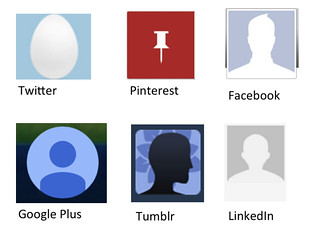
What's your profile?

DSC_1828Roses are red, violets are blue
Who are you?

Egg for photo
Equal to zero 

Profile blank
No rank

Nothing down
Not is this online town

Blank ProfilesNo image for your face
Failure in online space

No description
No depiction

An online name
With no aim

Deciding
Need some chiding

For online herds
The Eternal HandshakeDescribe in words 

Say hello
Let us know

Online scripture
Upload a picture

Up to us
On the online bus 

Narrate a few 
Connect with you
Blog Marketing Up Close Blue Pen Graphic
Give us a view
Follow you

Know you
Friend you

No longer a trial
What's your profile?


Creative Commons License
What's your profile by Anne Mims Adrian is licensed under a Creative Commons Attribution 3.0 Unported License
http://blog.anneadrian.com/2013/11/whats-your-profile.html  Based on a work at blog.anneadrian.com

This poem is written out of my frustration in seeing many great professionals who are dipping their toes in the social media waters and are limiting their professional and personal learning because they are not adequately describing themselves in profiles. 

Their bland presence means that they are not reaching the potential in building relationships. They don't realize what they are missing. 

Complete that dang profile!


Sunday, November 3, 2013

Do the Math: Cooperative Extension's Reach

While trying to obtain some information on some recent tweets, I ran a TweetReach report* on my last 50 tweets-something I have never done for my own tweets. I found the tweets I was looking for, but I also was totally surprised by the the number of accounts that could have seen my tweets. The last 50 tweets in the last 4 days including my name reached 36,000 accounts. Doing a little math and extrapolation, I can reach 63,000 accounts in 7 days. I then had to ask a "What if.." question. Imagine the potential if every Extension professional had a significant online following and presence.

How many Extension professionals can say that could have had anything they talked about have the potential of reaching 63,000 people in a week?

It is rather silly to think that every tweet was seen by every account. Here is expanding the "What if.." scenario. What if 10% of the 63,000 accounts saw tweets from me? That means 6,300 people in a week read something I wrote. How many Extension professionals could say that 6,300 people read something they wrote in the last week--or every week?

This post is not about me--it is a demonstration. It is about What if each Extension professional had a a substantial and meaningful online presence?

Almost 4,000 people follow me. Although I believe some Extension professionals could have many more than 4,000 followers, I am assuming that most Extension people will have fewer people follow them in Twitter (or in any other network). Now, let's do more more math and estimation.

If each of the 15,000 Extension professionals had 2,000 followers, then as an organization, Cooperative Extension, we could have the potential of reaching 47 million people (20% of the U.S. population) in a week or a realistic 23,000 people in a week. By the way, 15 to 20% of the adults in the U.S. use Twitter, and many more use Facebook.

What if 2,000 followers is too aggressive? If each Cooperative Extension professional had a following of 1,000 people, then Cooperative Extension would have the potential of reaching 23 million people (10% of the population in a week). That percentage is very close to the percentage of adults who have said that they have used Cooperative Extension (according to the Copernicus  study).

This Google Doc Spreadsheet shows my calculations.


As I did this estimation, here are some of my additional thoughts in creating online presence.

  • Creating an online presence does not exclude from having a strong local face-to-face presence. 
  • My interactions from week to week change a bit. For instance, this week I interacted with a few accounts I have never interacted with before. My engagement ebbs and flows as I learn from new people and interact on different topics. Therefore the people who read my tweets and interact with me are not always the same from week to week.
  • Cooperative Extension and land-grants are missing out on a lot of potential because our faculty, educators, and professionals are not online--opportunities are lost. 
  • We are also not reaching our potential because Extension professionals who are online are being too conservative in reaching people whom they don't know. 
  • Most of my interactions are with individuals and not very often with organizational accounts. Interactions and sharing best happens with people -- not with organizations. Thus, the reason we need to pushing for individuals to work in social media.
  • Twitter is my most active account and it is the easiest to measure interactions. I am also online in several other accounts. While Klout has many faults, it does provide some relative metrics. Using Klout, these are my accounts where I interact. These are listed in order of the "graded" interaction: Facebook, Instagram, LinkedIn and Google +. Any of these accounts can be used for connecting, conversing, and learning from others. 
  • I am not advocating that every professional has to be active on Twitter, though Twitter is by far the easiest to use. I am trying to make the point that if each Extension professional were to create a strong online presence, then we could become a lot better at reaching more people than we are currently. 
  • It has taken me 6 years to build a following of 4,000. I don't use any automated services for following or unfollowing. I have learned to be more liberal in choosing who to follow.
  • As I become more active in any given network, I gain more followers and increase interactions. 
  • It takes assertive efforts to get the value of online networks and connecting with others.
  • There is nothing Cooperative Extension is doing from a traditional standpoint that comes even close to reaching this kind of potential.  The "Connectedness" discussion of my virtual keynote to Iowa State Extension, describes a part of Cooperative Extension's reach problem. In the Copernicus study, it is recommended that Cooperative Extension brand ourselves better. However, I firmly believe we must also be doing more individually.

If you don't know how to get started or how to improve your online presence, start by becoming involved in the Network Literacy CoP.

*If you are wondering TweetReach accounts for duplicates. For instance, my colleague +Rusty Presley (@rpresley) and I have some of the same followers. In the calculating the accounts reached, TweetReach takes in account duplicate followers.


Sunday, September 15, 2013

Is it really a problem?

I find solace in that I am not the only one who feels this way. MTV's Bill Flanagan of CBS Sunday Morning finds the phrase, "no problem" to be a problem. 


About three years ago in a instant message when I asked for help from a colleague, I said "Thank you" he replied "np".

This happened a few more times with different colleagues in instant messaging until I looked it up. "np" is a short form meaning "No problem". Honestly I was still perplexed. What does that mean?

When someone is doing their job or exceeding their job and someone else recognizes the effort by saying "Thank you" why is the response "No problem"? It made no sense to me.

Not until recently when I was with a friend who thanked a waitress for bringing our drinks to the table, the waitress replied with "No problem" and my friend blurted out "I hate that phrase".

Immediately I found kinship. "Why?" I asked.

He said, "What does 'problem' mean?"

I said "A 'problem' means something is wrong."

His response "Right, a negative, a bad situation or issue."

By saying "No problem" one is implying that there is not a negative or bad situation. A person doing a service as part of his/her job should not see that task as a problem.

When one is doing one's job, why would one turn attention to a potential problem--negative issue--when one does not exist. Doing one's job, paying attention to others, reacting in ways of service or solving problems is opposite of a negative connotation.

When excelling at at a task, one is at the other end of the spectrum from the negative. The "No problem" response is rather silly.

When is it that "no problem" is an appropriate response? Maybe, when a customer asks, "Would it be a problem to do ..?" and then the appropriate response could be "It would be no problem to ..."

Words having meaning. Giving service at the minimum maybe one's job. Making a customer feel like you enjoy waiting on them gives meaning to your service.

What are more appropriate responses? A simple "You are welcome." A better answer is "My pleasure." What are others? Whatever your response is, don't indicate that it could have been a problem.


Friday, August 23, 2013

Jim Novak--quietly influential in my early career


About this time of the year 25 years ago, Jim Novak hired me to become a Microcomputer Specialist. I had just finished my Masters in Agricultural Economics. In 1987, there was a need for training, support, and direction is using computers but few people thought computers were worthwhile the effort and time. Most certainly discounted the importance of computing and technologies that linked us to each others. For instance, networking online and using Mozilla made little sense to most--few saw the value. In fact, I remember one Extension agent in a meeting vehemently declaring farmers would never use computers. We see how well his prediction held out. Farmers are some of the most technologically advanced small business owners around.

During the years, I have found lots of energy in helping others understand that the future does not look like the present. Over the last 25 years, technology has changed the way we work and how we communicate, collaborate, learn, and socialize. These advancements give us access and connections to people we would have never met before. Networking online serves as our gateway to diversity of thoughts.

Jim Novak and Gene Simpson understood the significance of connecting professionals and clientele. They provided a vision for Alabama Cooperative Extension System that set a stage and ignited our efforts in front of most Cooperative Extension services. An important piece of this vision was Gene's hiring Jonathan Davis to develop a wide area network for Alabama Cooperative Extension in 1987.

Jim Novak at his retirement reception in Comer Hall
I am very grateful that Jim saw something in my own talents and abilities that I did not. He gave me a great start in my career with a great organization--Cooperative Extension. Jim and Gene allowed us in the technology unit to use our own ideas in a constantly changing environment. That freedom was essential to my professional growth.

Though it was not clear at the time, Jim's faith in my talents gave me a confidence to keep rowing in uncharted waters throughout my career. I am still trying to convince people to see the future in way that does not look like that past or the present.

Thank you Jim for having faith in me as I was a young professional. And, thank you for your service to Alabama Cooperative Extension.

Enjoy your retirement!


Tuesday, July 9, 2013

John Seely Brown's Global One-Room Schoolhouse

Thanks to Stan Skrabut sharing this video in Google Plus.


The Global One-Room Schoolhouse: John Seely Brown (Highlights from his "Entrepreneurial Learner" Keynote at DML2012) from DML Research Hub on Vimeo.

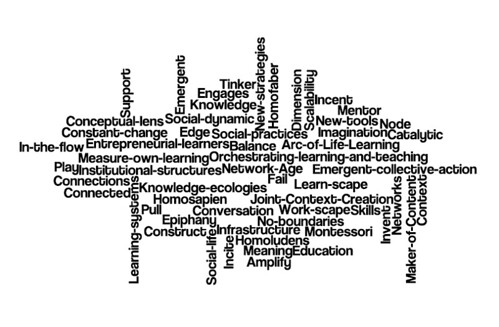
I watched John Seely Brown's video Global One-Room Schoolhouse and Entrepreneurial Learning twice and wrote down words and phrases that resonated with me as important to understand. Some are concepts that I am afraid we are not seeing and understanding because we are so very tied to the traditional, one to many, industrial educational model.
John Seely Brown Global One Room Schoolhouse
As knowledge workers and educators, we are responsible for understanding our own effectiveness and lack of effectiveness and for understanding how our work and decisions will affect our failure or success in the future.
If institutional structures of learning--institutions of schooling, universities and research universities education and universities and look the same as they do now, we have problems. (paraphrased around 1.12 mark)
Recently I have seen reports from some administrators and educators on the skills that they think that we need in the future for public education. The report was disappointing because what some educators see as necessary for the future is based on the way we have worked in the last 30 years.

Brown's analogy of the advantages and environments of the one room schoolhouse reminds of the effectiveness and why we should be return to Seaman Knapp's and George Washington Carver's Extension models.  

Access to more and different kinds of information, joint context creation, co-learning, and contextual ubiquitous learning means we should be asking:
How do we transform from a slow moving steamship set on a course to kayaking into the flow?  (paraphrased around the 2::00 minute mark)
We better be creating arcs of life learning, creating content in joint contexts, participating in ever-changing knowledge ecologies, and orchestrating learning for ourselves and others.

I would love to see examples of institutions looking at learning in this way. Hopefully, you can point me to some examples.


Monday, June 24, 2013

Alternative Keynote Session

Tomorrow I will be discussing elements of the Iowa State Virtual Conference Keynote address Continuous Beta and a Healthy Dose of Paranoia in a webinar. We hope to have some discussion at the end of the 45 minute webinar.

Other information and connection information can be found: https://learn.extension.org/events/1110

Please join us on June 25, 2013 at 3 PM Eastern. If you can't attend the archive will be added to the website above in a few days.

The recording of this keynote is located https://connect.extension.iastate.edu/p2ehodt6g48/